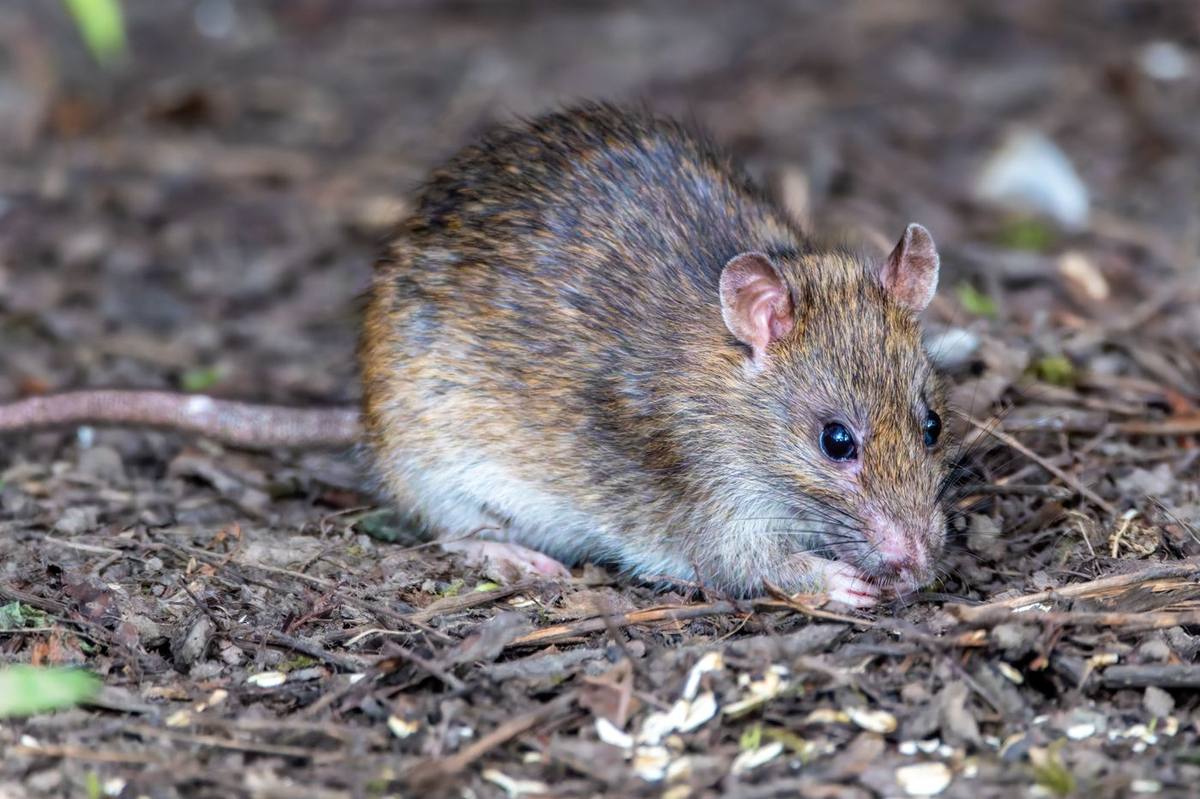
Roof rats are slimmer, with a tail usually longer than the head and body, and they nest high in attics and trees. Norway rats are stockier with a blunt nose and a shorter tail, and they burrow near foundations. Texas Tech's Mammals of Texas calls roof rats common over most of Texas, especially in towns.
Dealing with it right now? Skip the reading and talk to a local rodent technician.
(254) 263-4080Two rats, two habits
Almost every rat call in the Waco area involves one of two species. They look similar running across a yard at dusk, and they behave very differently.
The roof rat, also called the black rat, is a climber. The Norway rat, also called the brown rat, is a digger. Treating a roof rat problem like a Norway rat problem means traps on the ground while the rats run the rafters overhead.
Roof rats
Texas Tech’s Mammals of Texas lists average measurements for the roof rat of about 370 millimeters total length with a 190-millimeter tail, roughly 14.5 inches overall with about 7.5 inches of tail. Adults weigh up to about 200 grams. The tail is usually longer than the head and body, though not always. The fur is blackish or brownish.
The same account calls roof rats common over most of Texas, especially in towns, and says they usually frequent attics, rafters and crossbeams. They travel along pipes, beams, wires and wall studs and can leave a dark, greasy trail.
In Waco, roof rats do well in neighborhoods with big trees, like Castle Heights, Sanger Heights, Brook Oaks and Woodway, where limbs and power lines give them a path to the roof.
Signs of roof rats:
- Scratching and scurrying in the ceiling at night
- Droppings on top of the attic insulation, about half an inch long
- Rub marks on rafters and along the top plates of walls
- Gnawed fruit or pecans in trees
- Activity near the eaves, soffits and gable vents
Norway rats
The Norway rat is heavier. Cornell’s IPM program puts its body length at up to 11 inches, with a slightly shorter tail, for about 16 inches total. Arizona’s extension guide describes a stocky body with a blunt nose, averaging about a pound. Texas Tech’s roof rat account describes the Norway rat as larger and more aggressive.
Norway rats usually nest in underground burrows, often near foundations and under piles of debris. In Waco, that means slab edges, under sheds and decks, along fences, beside compost and along creek banks and drainage channels. The Brazos and Bosque rivers and the creeks that feed them give them plenty of ground to dig.
Signs of Norway rats:
- Burrows about 2 to 3 inches across along the slab, fence or shed, with loose dirt at the mouth
- Packed trails through grass between burrows and food
- Droppings in the garage, crawl space or along the outside wall, three quarters of an inch to an inch long
- Gnaw marks low on doors and walls
Side by side
- Body: roof rats are slimmer with a pointed muzzle; Norway rats are stockier with a blunt nose.
- Tail: roof rat tails are usually longer than the head and body; Norway rat tails are slightly shorter.
- Nest: roof rats nest high in attics, upper walls and trees; Norway rats nest low in burrows and crawl spaces.
- Droppings: about half an inch for roof rats; three quarters of an inch to an inch for Norway rats.
- Entry: roof rats come in at the roofline; Norway rats come in at ground level.
Breeding
Texas Tech says roof rats breed throughout the year, with peaks in February and March and again in May and June. Gestation is about 21 days, litters average nearly seven young, and young can reproduce at about three months. That’s why a few rats in spring can be a real problem by summer.
How the plan changes
For roof rats, the technician traps in the attic and along roof runs, seals soffits, vents and roof-to-wall joints, and recommends trimming limbs back from the roof. The rats in the attic article covers this.
For Norway rats, the technician traps at ground level, treats and collapses burrows, and seals the slab edge, skirting, weep holes and garage. Rat burrow treatment explains that work.
Both need sealing. The wildlife damage group says rats can get through openings larger than half an inch, so a technician checks every gap at that size or larger.
When it’s both
Some Waco homes have both: roof rats in the attic and Norway rats under a shed in the backyard. That’s common on older lots with big trees and outbuildings. A good inspection checks high and low, and rat control handles both.
Done reading and still finding signs? Get a technician to look at your house.
(254) 263-4080